About

The publication for AI music creators

Rendered Sound exists because the interesting question was never “did a machine help?” It was “what did you actually decide?”

Rendered Sound is free to read and free to use. There is no subscription, no paywall and no account required — the essays, the music, the challenge and all three tools are open to anyone who lands here.

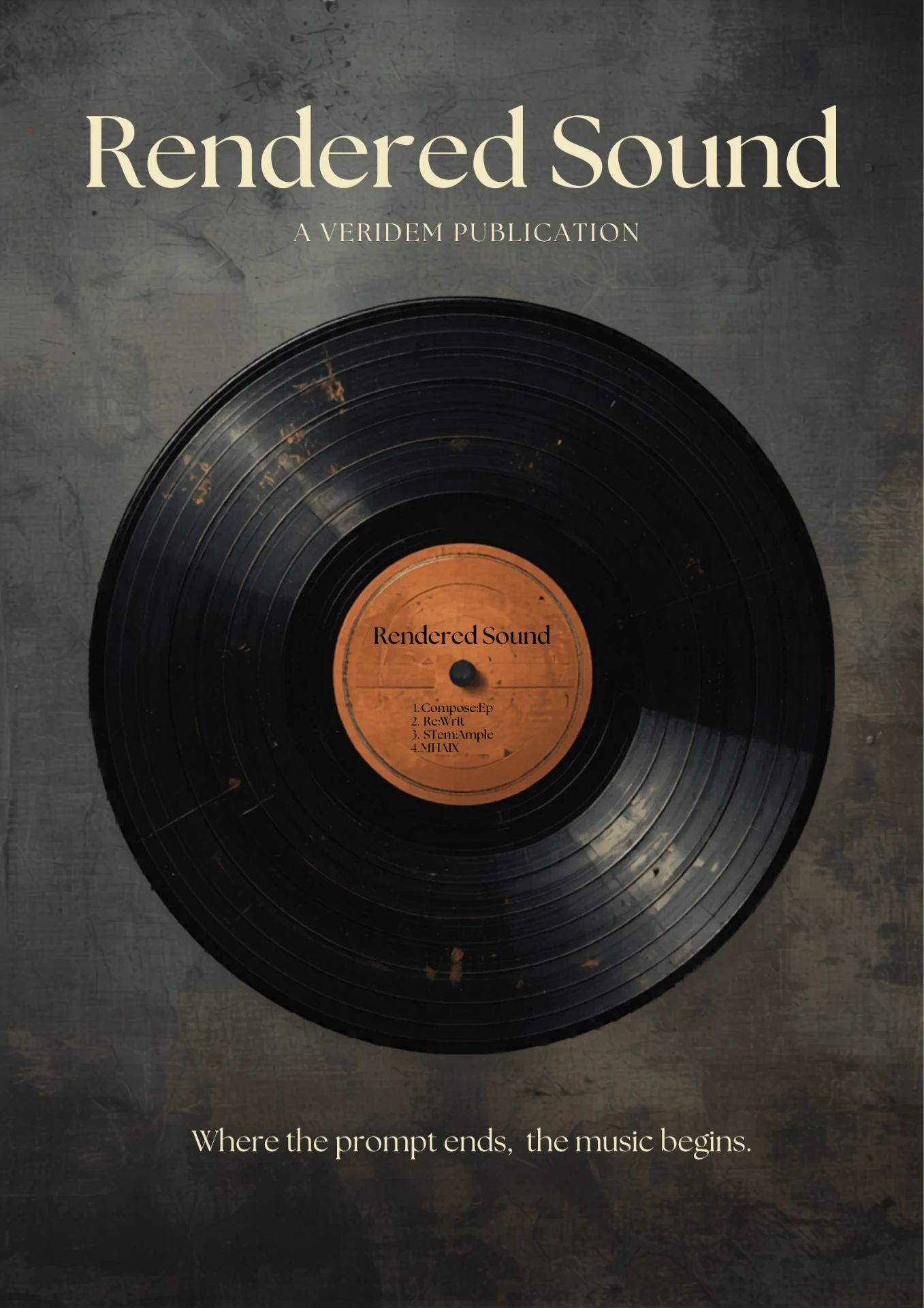
Rendered Sound vinyl record — A Veridem Publication

The mark of the publication: a record on graphite, gold in the grooves. Everything Rendered Sound puts out — essays, releases, video, the Challenge — presses onto the same record.

The Drop

Original releases with credits and behind-the-scenes breakdowns — the decisions, the dead ends, the takes that didn't make it.

The Craft

Editorials on authorship, taste, tooling and the culture forming around AI-assisted music. Some run on Substack, some live only here.

The Rendered Challenge

A monthly prompt with a real constraint and a public result. Craft and documented authorship over prompt trickery.

What's on Rendered Sound

What Rendered Sound publishes

Rendered Sound publishes craft essays on AI music authorship, copyright and the industry, written by a working practitioner rather than an observer.

The editorials are written by C. Niki Mclamb-Doanes — a perioperative registered nurse and the founder of Veridem Holdings Inc. — and they come from actually making the records, not from commenting on other people's. Recurring subjects: who owns a song when a model helped write it, what copyright currently recognises and what it doesn't, how taste survives a tool that will generate forever, and what the business of music is quietly doing about all of it.

Some essays run first on Substack; every one of them lives here in full.

Read the editorials ↗

How the music is documented

Every song released on Rendered Sound is published together with the full record of how it was made, not just the finished audio.

This is the part of the site that exists nowhere else in this shape. A release page in The Drop carries the track, and underneath it the whole working file:

  • The actual prompt used — the text that went into the model, printed as written, not summarised after the fact.
  • The AI engine — which system generated the audio, and at what stage it entered the process.
  • Tools used — every editor, plugin, studio and instrument that touched the track on the way to the master.
  • How many generations were rejected — the count of takes that were made and thrown out before one was kept.
  • What was changed by hand — the arrangement moves, re-sung lines, tempo and pitch edits and structural surgery done by a person after generation.
  • The MHAIX authorship score — the track's rating on the MHAIX scale, broken out by dimension rather than given as a single number.
  • What didn't work — the dead ends, in writing, including the versions that were better on paper than in the room.

The point of publishing all of it is simple: a song that shows its decisions can be argued with. One that doesn't can only be believed or dismissed.

Hear The Drop ↗

What the Rendered Challenge is

The Rendered Challenge is a monthly remix challenge in which entrants rework a published source track and document the work through a nine-step worksheet.

Organisers put up a source song along with its original prompt, lyrics and style notes. Entrants take it somewhere else and record how they got there: the new prompt, whether the musical style was revised, the structural changes, an AI critique, their own self-critique, and the final remix with its finished lyrics and prompt.

Completed entries are reviewed across five MHAIX authorship dimensions — Composition, Lyrics, Production, Curation and Iterative Labor — on a 0–40 scale. That review is an exposure to how MHAIX thinks about authorship, not an MHAIX score or certification. There is also a practice warm-up you can run end to end without submitting anything.

See the current challenge ↗

Separately, Spotlight runs a monthly video interview with an AI music artist, each with a plain breakdown of what the artist did and what the AI did.

What the Listening Room does

The Listening Room takes the lyrics and written context you paste in and gives back a candid, A&R-style read on the song.

It reads text — your lyrics, and whatever you write about the intent, the arrangement and the audience. It does not analyse uploaded audio files. That distinction is worth learning here rather than discovering it halfway through: no tool on this page listens to your mix. The read is about the writing and the thinking behind it, which is where most songs are actually won or lost.

It is free, limited to two reads per visitor per day, and nothing you paste is stored. If you want a lyric workspace that keeps your drafts and your decisions, that's Re:Writ.

Open the Listening Room ↗

What 8-Ball Vinyl does

8-Ball Vinyl takes two ingredients — any two words — and gives back a complete production brief you can paste straight into a generator.

Type an artist, a mood, a time of day, a weather system, a city. Set the genre dial, the Mild-to-Chaos variation slider and the tempo, or leave them on Auto and let the genre choose. Spin the record and a brief comes out: texture, tempo feel, drums, a scene, arrangement instructions, then the genre and BPM.

It runs entirely in your browser, costs nothing and there is no limit on how many times you can spin it. To turn one of those briefs into a saved blueprint with documented decisions, that's Stem:Ample.

Spin 8-Ball Vinyl ↗

What Overdub is

Overdub is a single-player card game about finishing a song before the machine does.

You build a track across a timeline board from genre, instrument and wild cards while a B-Side opponent races to claim the same song. There's a timer, a bank, effects and Ghost Tracks, a daily challenge and a leaderboard. The result maps to the MHAIX authorship scale, so the game is quietly making the same argument the rest of the site makes: what you decided is the thing being scored. Free to play in the browser.

Play Overdub ↗

What In the Room is

In the Room is where Rendered Sound puts process video: sessions, walkthroughs and footage of the work as it actually happened.

Written breakdowns can only carry so much. The video page carries the rest — a take being rebuilt, a decision being made out loud, the version before the version that got released.

Watch In the Room ↗

Who the Voices are

The Voices are Rendered Sound's disclosed virtual artist personas — named characters with their own point of view, steered by a human at the console.

They are disclosed as personas everywhere they appear. A release credited to one of them still carries the same documented production breakdown as everything else in The Drop, and the same AI disclosure applies. For releases assembled as an EP, the sequencing and release decisions are documented in Compose:EP, live now at composeep.com.

Dizzy Rey at the mixing console, Skyline Soundworks control room
Virtual artist · 01

Dizzy Rey

Dizzy Rey is one of the virtual artists behind Rendered Sound's releases — a persona with her own voice, taste and point of view, steered by a human at the console. When a track carries her name, the decisions behind it are documented the same way everything else here is: out in the open.

Hear her on the Music page

What the AI disclosure covers

Rendered Sound publishes its own AI-use policy, stating where AI is used across the site and where it isn't.

It covers the music, the artwork, the writing and the tools, and it is written to be read by a person rather than a lawyer. If you want to know what a human did on any given piece of work here, the disclosure is the starting point and the per-release breakdowns are the detail.

Read the AI disclosure ↗

Common questions

What is Rendered Sound?

Rendered Sound is a music publication from Veridem Holdings Inc. that publishes AI-assisted music together with the documented human decisions behind it — essays on craft and authorship, released tracks with their full production breakdown, a monthly remix challenge, process video, and three free interactive tools.

Is Rendered Sound free?

Yes. Rendered Sound is free to read and free to use. There is no subscription, no paywall and no account required to read the editorials, hear the music or use the Listening Room, 8-Ball Vinyl or Overdub.

What does the Listening Room do?

The Listening Room takes lyrics and written context you paste in and returns a candid A&R-style read on the song. It reads text — your lyrics and the context you write about them — and does not analyse uploaded audio files. It is free, limited to two reads per visitor per day, and nothing you paste is stored.

What is Overdub?

Overdub is a single-player card game about finishing a song before the machine does. Each round builds a track from genre, instrument and wild cards against an AI opponent, and the result maps to the same MHAIX authorship scale used across the Veridem ecosystem. It is free to play in the browser.

Does Rendered Sound show the prompts behind its music?

Yes. Every release in The Drop is published with its production breakdown: the actual prompt used, the AI engine, the tools involved, how many generations were rejected, what was changed by hand, the MHAIX authorship score and what didn't work.

Who writes Rendered Sound?

Rendered Sound is written by C. Niki Mclamb-Doanes, a perioperative registered nurse and the founder of Veridem Holdings Inc., writing as a working practitioner rather than an observer.

What is the Rendered Challenge?

The Rendered Challenge is a monthly remix challenge. Organisers publish a source track with its prompt and lyrics, entrants remix it and document the work through a nine-step worksheet, and entries are reviewed across five MHAIX authorship dimensions — Composition, Lyrics, Production, Curation and Iterative Labor — on a 0–40 scale.

Rendered Sound is a Veridem Holdings Inc. publication. Veridem builds authorship infrastructure for the creative economy — tools that document human creative control so the work stays yours. Rendered Sound is the stage where those tools get used in the open, on real records, with the process visible.

You can also play Overdub, our card game about finishing a song before the machine does. It maps to the same MHAIX authorship scale that runs underneath the rest of the ecosystem.

New work lands here and on Substack.

The Veridem Ecosystem

One ecosystem · from the first prompt to the final release

6 products · 1 flywheel